So I got an EEG...
A weekend measuring my brainwaves.
A few weeks ago I bought an EEG from a kind person in my independent science discord, at a pretty generous price. Electroencephalography measures the fluctuations of electric signals in the brain that happen in ion channels. I got one because, well, I was just curious… haha . And on a side note - I’m pretty optimistic about scientific communities that buy and sell used equipment to each other! I’ve been trying to find gems from auctioned equipment from biotech startups that have gone out of business too (thanks David), but they usually are really annoying to go and pickup.
Anyway, the openBCI EEG comes a handy cap that pre-places the electrodes. It’s fairly simple to set up, I just attached each terminal from the cap to the respective pins in openBCI’s Daisy and Cyton boards. Then it transmits via radio signal from the chip to a USB dongle that goes into my computer. I got Claude code to troubleshoot my setup after I had some syncing issues with the radio channels.
Then I put the cap on and it looks like this. (Excuse my messy house and disassembled bike).
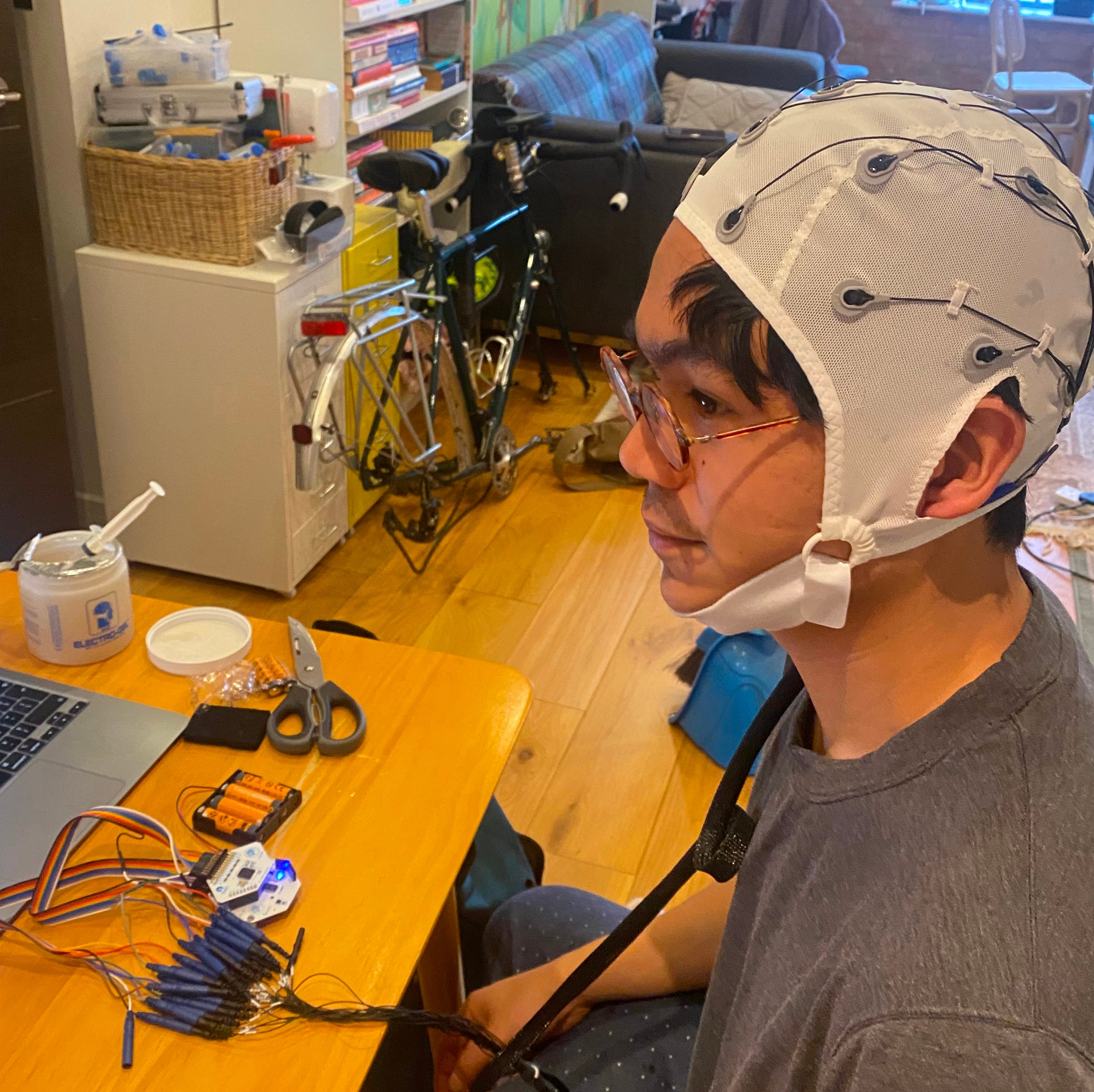
The most annoying and messy part is having to put electrode gel between your scalp and the electrodes to get a better signal. Amelia had to get a syringe and then squeeze electrode gel through the cap and into my scalp. It’s pretty messy and takes a while to clean. Because of this, I’m quite excited for non invasive brain interface technology that doesn’t rely on electrode gel, or algorithms that somehow remove the noise you get when not using electrode gel.
This particular setup has 16 channels that are attached to different locations on my head.
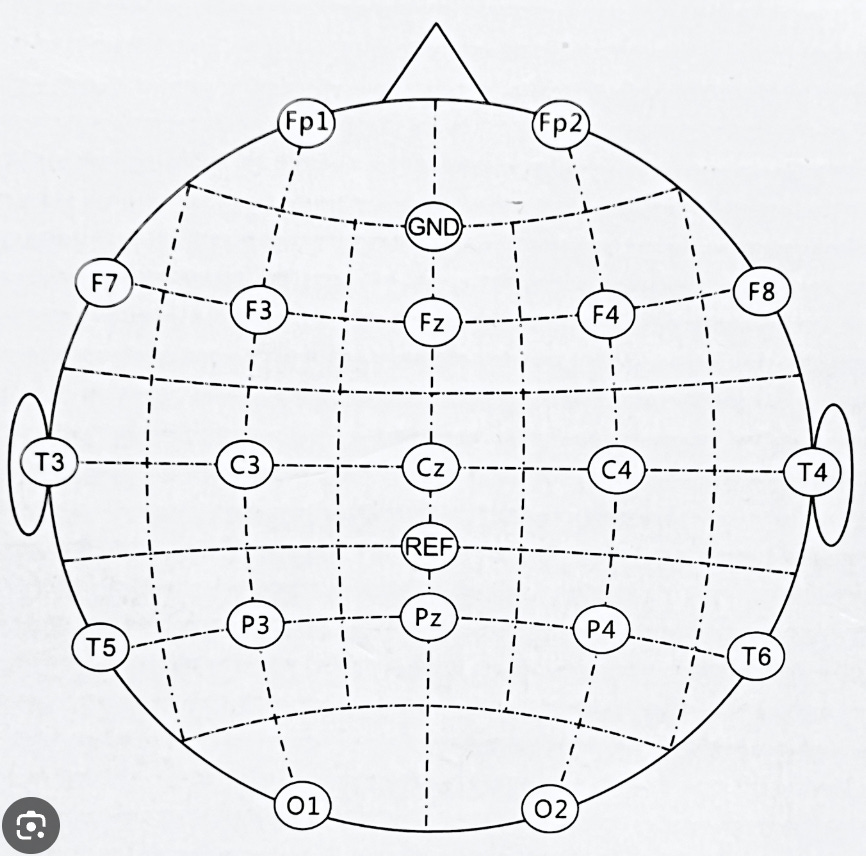
Once I got the connection working I started recording my brainwaves. For a bunch of the channels, the signal looks like it’s corrupted, or ‘railed’, which probably means I didn’t get the electrode connection working properly. But the others look fine. You can see a live recording here. The left hand side is a rolling timeseries of the waves associated with each channel, and the right hand side is a spectrum plot that moves realtime.
Amelia and I did some pretty basic tests like how the waves changed when she played classical music, or scared me by surprise. Usually something changed but there was no real discernable pattern (so far).
From my discussions with my theoretical biology reading group, I’m more optimistic about experiments that look at more macro type variables, both because I think it’s been underexplored but also because I think it’s more amenable to experiment and independent scientists. Having this in my home gives me access to much more data (myself), and also lets me explore the realm of extended measurement not available to university researchers - for example, how much EEG data is out there on people taking a shit?
I didn’t have much of a plan on what I’m going to use it for, but my main idea was either time series modelling or some sort of mapping of cognitive ability with air quality levels.
On the time series stuff, I’ve been looking a lot at DMD and EDMD and I wonder if there is something to do there.
On the air quality stuff - for the most part I’m focused on ways to prevent pandemics, but as a route to adoption I’m also interested in looking at air quality and performance. at For example, I’d be keen to know if I could get some signal in the EEG spectrum when CO2 levels rise, as evidence to weigh into the CO2 versus cognition debate.
As a corollary, I’m wondering if I could get better signal into the best times to do things, other than just guessing an optimal schedule. But I think this is hard. There seem to be other research groups trying to do cool stuff with EEGs though.
EEGs are a lot of fun, and the related EMG (for muscles). The Muse S is pretty cool and accessible for less mess, but only has 4 electrode points.
If you do mediation, there is lots of interesting research on that as well.
It's also super interesting for sleep health, seeing your periods of dreaming, deep sleep, movement is all super interesting.