Models for Cleaning Air
Fluid physics is fun
I’ve been trying to figure out ways I could help in the indoor air quality space. I think there is evidence that Far UVC light can be effective for cleaning air, whilst being safe to skin and eyes in the right dose.
But modelling far UVC is complicated. Suppose I put such a light on my ceiling. How effective is it going to be at reducing infection rates at a house party? Fluids, aerosols, viruses, people, and light are difficult to model.
Right now, people use a technique called CFD. This involves using a computer to solve the Navier-Stokes equations that govern a room’s air and aerosol flow. This is then coupled with UVC light distribution and inactivation terms to see how pathogen concentration reduces over time.
But there are a few sticky points here. CFD can be slow to compute. It also requires the practitioner to specify a lot of free parameters, like the stickiness of the wall, turbulence assumptions, eddies and more. This makes it hard.
Given the fact that modelling is always going to be a coarse task, I want to understand what factors really actually matter. I’m not saying we should stop doing CFD. But a simpler model that replicates most of the CFD, with fewer parameters, would be great.
Such a thing would scalable and easy to interpret, and could be rolled out to lots of UVC installers.
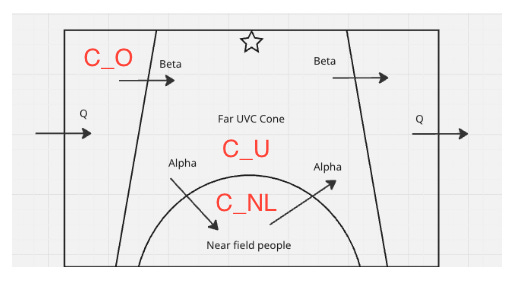
These are called zonal models / lumped parameter models. These types of reduced models are already done for fire modelling, to see how temperature spreads in a room.
So today, I tried to make one for a Far UVC installation. Technical details, math and the full model is here.
Disclaimer: not medical advice, all views are strictly my own.
Absolutely no idea if what you wrote was correct but I did enjoy reading and not understanding it