How To Read Something
The book is a block of wood. You don't stare at blocks of wood.
I've been working hard on increasing my learning techniques, but the fact that I'm still discovering really useful techniques as an adult has made me realise that I still have a long way to go to the peak of learning efficiency.
In particular, I used to think I was good at reading. Trying to do good science at home requires it, because you need to think hard about what you want to investigate. But after a real concerted effort to read better and more efficiently, I realise that I don't know how to read at all. And this is scary because I read a lot. So if I spend time reading without knowing how to read, I might just be wasting my time!
I wanted to figure out what reading properly actually means, and how I might do it. This essay is my attempt to do that. I also found that there isn't really a good set of essays out there that try to answer the question of reading something critically, so I'm trying to contribute to the literature on this. Also I realised that they don't really teach you the philosophy of how to read something in school.
So here goes.
What does reading mean?
First I asked the basic question. What does reading mean?
Suppose an alien came down from a spaceship and observed me whilst I was reading my book. And suppose this alien had some hyper-sensory capabilities so that they could see the electric signals in my brain. What would they observe?
This alien would probably conclude that the human act of reading involves a simple physical and biological sequence. First, the human looks at a string of words on paper with their eyes. The light reflects off the page. And then the light is absorbed via their optical nerve. The nerve sends electrical signals to the brain.
And then the human brain does something (?).
This is ambiguous and unclear - what does this something in the brain mean? I'm not a neuroscientist, but I know enough neuroscientists to confidently claim that this is unclear.
Even avoiding the brain electrochemistry question, the first reason it's unclear is because we have different languages, so people build different associations with different words. And secondly, for people who speak the same language, it is likely that we think different things even when we read the same word. For example, if I'm raised in Malaysia, I might associate a bottle of water to be shaped like a long and thin Dasani water bottle. Whereas some rich person in the UK might associate a water bottle with the short and fat Evian bottle.
The problem is that this word to mind's-eye mapping is completely unobservable unless we invent some sort of high fidelity imaging device!
So I tried to think of this question from a different perspective. Maybe 'what is reading' is the completely wrong question to ask. So I had a think about what the right reframing might be and I thought the following:
Instead of what does it mean to read something, maybe the right question is... what do I want out of reading?
What do I want out of reading?
Ok, so now the question is a bit more internal, a bit more unique to my own thoughts and feelings, which makes the question slightly more tractable. When I engage in the act of picking up a book and staring at it, and engaging my brain, what do I want?
I realised that I was reading to do one of a few things.
The first reason is practical, which is to understand how something works. This is necessary for research because I need to understand what has already been done before extending it. For example, I'm thinking a lot about physics approaches to biology and so one book that I tried to read was Freeman Dyson's ferromagnetic model for life and death in cells. I also had to read about thermodynamics to get a grasp of the kinds of concept that would be useful in reasoning about biological problems. I'm trying to get a better handle of biochemistry now and that involves a lot of reading like Deduve's Blueprint of a Cell.
But the point is there's no real physically possible way I could've built these prerequisites without reading things, so I read. I don't think there's a way around this, and reading is good because reinventing the wheel every time is inefficient. The danger with self study is that you can fool yourself into understanding something when you don't. So reading serves as a bit of a hedge.
The next reason is to pick up knowledge that I think could be useful later on. Generally, reading about some area of basic science is always useful, and I like to keep a library of useful knowledge that I can use to attack a hard problem. Often times I buy books with no immediate plans, put them on the shelf, read a bit here and there, and pray that something comes in useful later down the line. Usually it does!
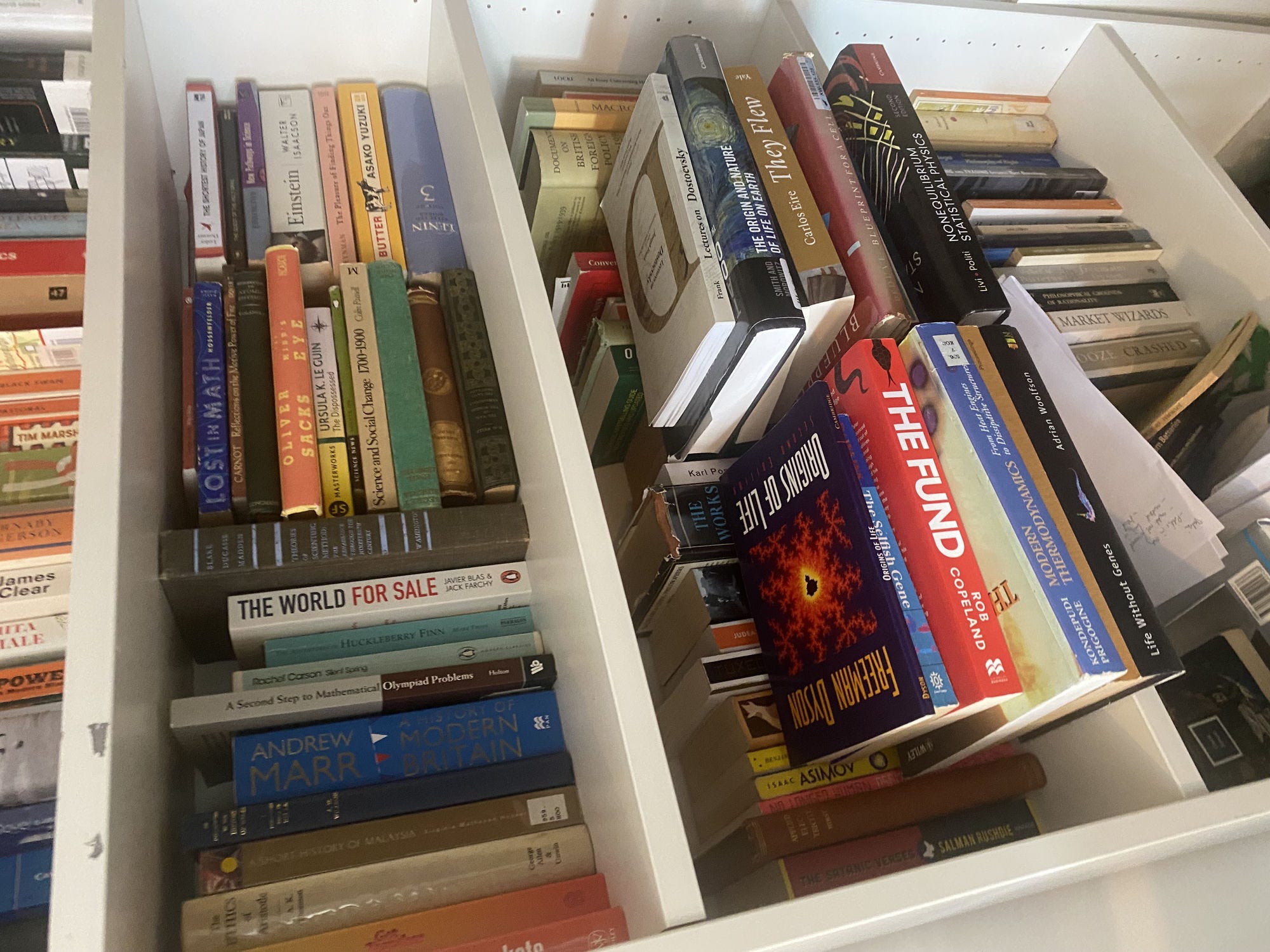
The next reason I read is to figure out how people did stuff. I read Alfred Loomis' biography by Jennet Conant to figure out if I could do science at home. I am reading Hasok Chang's Inventing temperature to learn how Lord Kelvin figured out that water boils at the same temperature. I found Murakami's memoirs on being a good writer useful in structuring my own time as a writer.
The third reason is practical but also mildly selfish. I get randomly curious about something and want to dig in. For example, I don't have much of a stake in Central Asian history, but for some reason I saw a lot of bike tourers trying to cycle across Tajikistan, and I really had to know what it was like. Like for example I really wanted to know what Tajikistan was like so I went down a rabbit hole and got a really dense book on the modern history of the Central Asian steppe!
And then the last thing is escapism or aesthetic. This is when I'm invested in the story, or the feeling of being immersed in text. This is usually what happens when I read fiction, like Steinbeck or Barbara Pym. This is cool too! I'm trying to find more time to read just to relax by getting immersed in a story - I'm thinking of setting a non-negotiable time in the day to do this.
And so apart from the escapism reason, all of the reasons above point to trying to extract something from a text so that I gain something from it.
So far, my best mental model for reading this is treating text like raw material. And then it's my job to do my best work to extract something of value from it. When you think of it like this there are already some corollaries. For example, the speed at which you finish a book is basically irrelevant. I have books on my shelves that I have been picking at for several years, reading different spots. And I think that's fine!
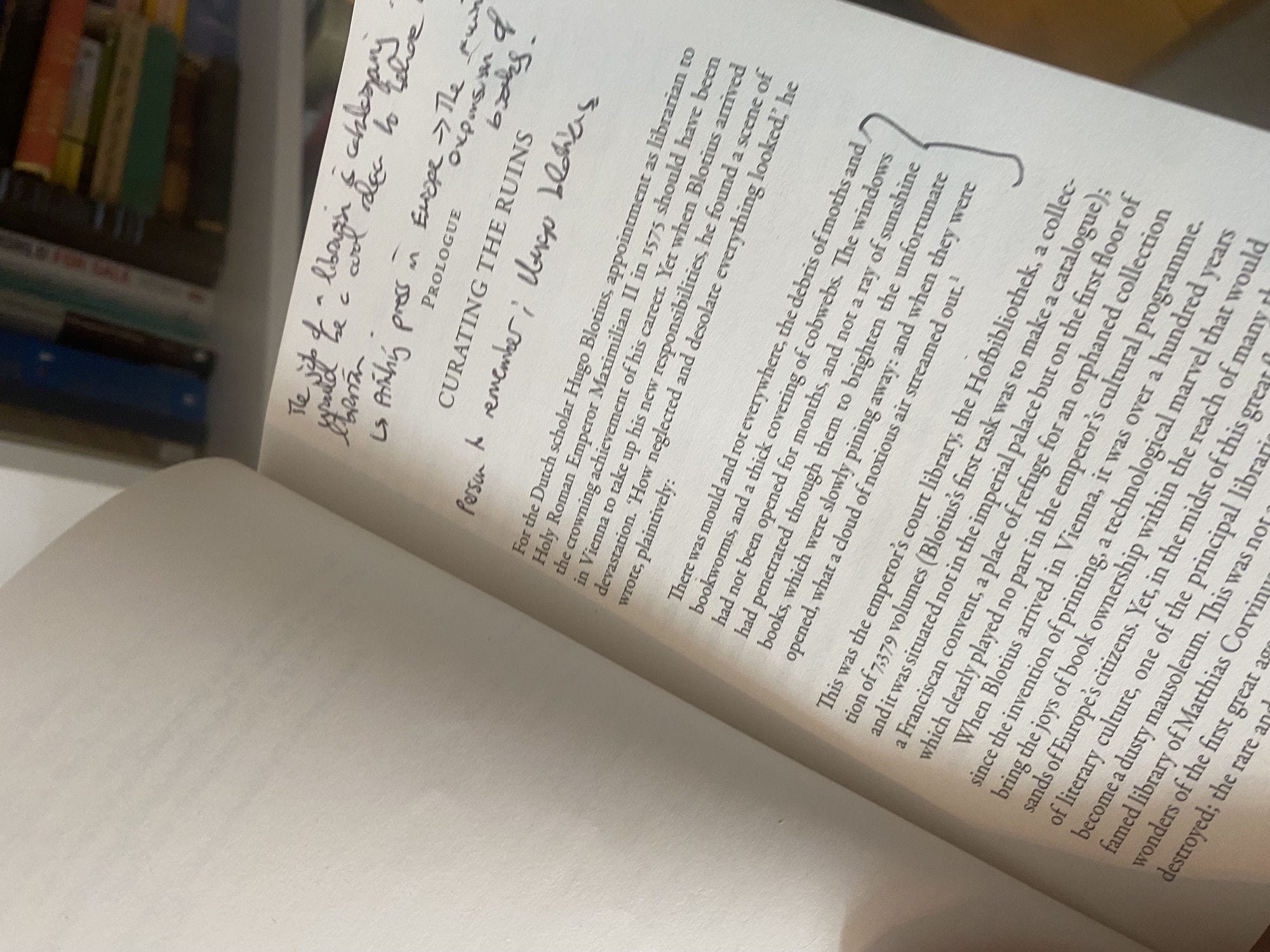
Also, if you treat a book like raw material to make things with, the way you interact with a book changes. I am more likely to scribble in the margins, or pick through a book in selective different chapters. Or maybe take photos of excerpts. I recently learned that people in the Renaissance era really scribbled hard over their copies of the Bible, partially because they had no paper. I think this is a cool thing to do regardless.
Now, I've found that my process in trying to extract things from books boils down to three questions.
What is the author trying to say?
Is the author correct?
How can I use the answers to those two questions above to make something?
What is the author trying to say?
The first thing I try to do is learn is what the author is trying to say. This is not a straightforward thing to do. You will never hit this exactly, but it's worth getting close. There seems to be debate around whether one can truly understand what someone else means, but if the author has done a decent job then it should be possible for the reader to get close to the intended message. This is probably more applicable to non-fiction, or text written by an author who tries to reduce ambiguity instead of increasing it.
Ask a lot of dumb questions about the raw mechanics of a text. Words are complicated and it's hard to know what the core concept is without considerable mental effort. Also, authors are lazy and likely do not cut stuff when they should. So the best way I've found to whittle down: my favourite thing to ask is 'what is the author claiming'. This is a question you shouldn't take for granted, and it is also possible that the author themselves do not have a clear idea about what they are claiming.
My heuristic is that you should ask 'what is the author saying' basically with every new page that you read. I try to write this in the margin. And the end result is that you should be able to describe in plain English what you think the author is claiming. The ideal thing I should be able to do is explain what the author means like a tree of recursion, which looks something like this:
The author is saying X happens because of Y
The author claims that Y causes Z, and then Z causes X
The author claims that Y causes Z because of reason R.
The author claims that Z causes X because of reason S
The author is confident in these reasons.
But the author admits that these reasons fail under conditions A, B, and C.
An example of me doing this is my expository piece on Dyson's toy model of the cell, where I spell out each claim that Dyson is making on the first part of the model.
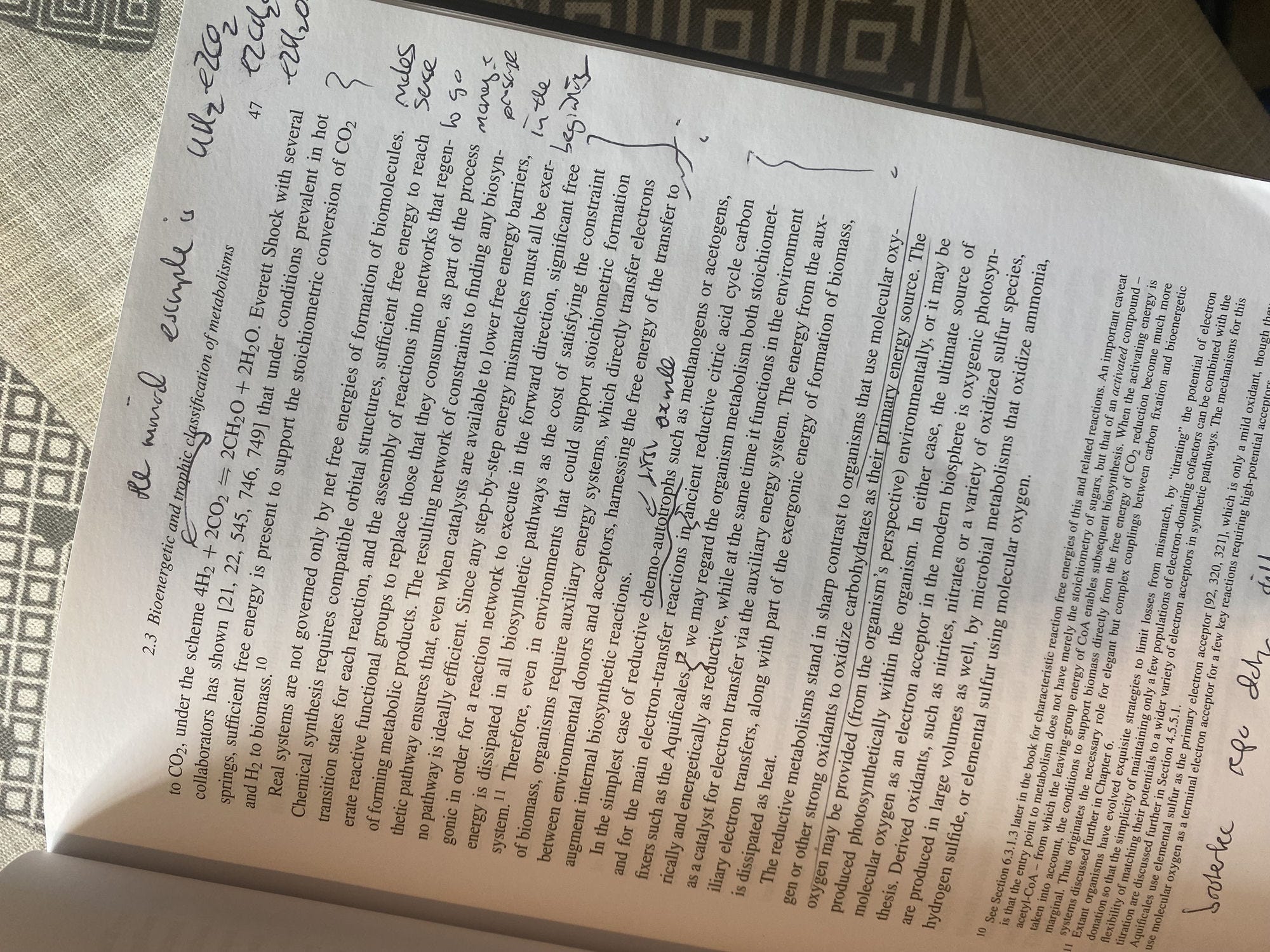
If both me and the author have done our job right then these two things should be close. A bonus that you get if you do this is that it becomes really clear where the weaknesses in an argument lies. Sometimes I wonder why authors don't write in this form to start with - maybe they don't like to show weaknesses in their argument?
Of course, if you are really brave, then the best way is to contact the author directly or comment on their work in public. I usually write a list of what I think the author is claiming and then send it to them. This is worthwhile, and I do this for a number of people that I collaborate with. I've been surprised many times in thinking I understood what an author is saying, but have been wrong.
Another approach to figure out what the author is trying to say is context. This probably sounds obvious but I don't think it's straightforward at all in how to contextualise a text properly.
Some obvious questions to think about regarding context include the physical data associated with a piece, like when and where the piece was written. But probably more important is the study of the wider debate that the writer is trying to engage in. For example, if the writer is claiming some statement X, then I try to understand what about the general scene made the author want to write that statement.
Another flavour of this is the motivations that the author has when writing. If you wanted to be pessimistic, you might need to ask if there's motivated reasoning and any incentive behind why the piece was written? For example, has the author received funding that might harm their objectivity? Do they have a corporation or reputation that they are trying to protect? Are they trying to sell you something? All of this matters!
In terms of reading literature or fiction, I've found looking at literary criticism to be surprisingly helpful, if you can find things that are not of the pretentious type. I remember reading Dostoyevsky quite intensely but I never really got a lightbulb moment until I read some of Joseph Frank's lectures on Dostoyevsky. Sometimes when reading a piece of fiction, especially historical, I've found it useful to just know how society works at the time, and Frank's discussions on atheism versus orthodoxy in Dostoyevsky's Russia really helped me digest the Brothers Karamazov better. But I'm still trying to figure it out!
Is the author correct?
Once you've figured out what the author is trying to say, the next level is whether the author is correct. This lies in the realm of critical thinking. Again, a word that has been abused by highschools but they never really tell you how to go about doing it.
My current approach to figuring out if the author is correct is to first build the tree of claims as I said above.
The author is saying X happens because of Y
The author claims that Y causes Z, and then Z causes X
Once you have done this, you can then attack two things.
First attack the assumptions. In the chain above the author takes it as fact that Y is true, where Y could be anything. My job is to really figure out if Y is true. For example, I was trying to critique my own writing, a piece on Brownian motion and its effects on milk, but I needed to check if milk globules were actually small enough to have significant brownian effects.
If you are reading a highly technical piece of work like theoretical physics, and you are struggling to build the causal chain, then it helps to build a toy model of what is being said. For example, suppose that the author is trying to propose some Hamiltonian in three dimensional space. As the reader, you might wish to try reduce the model to one dimension. Or you could try get an LLM to simplify things, with caution. Or, if you are really daring you could use a formal proof assistant like LEAN to verify the claims, which I've written about before.
Another thing you could attack is the logical links between things in the chain. For example, if the author claims that Y causes Z, then you might wish to address whether Y indeed causes Z. If it's a correlation argument then you have a battery of techniques to address if the causation is true. Does the author use logical fallacies like ad hominem or strawman? What if the context changes?
Another approach is to read criticism of the text. Yes, it sounds cliche but the phrase 'there are two sides to every story' is a saying for a reason. Better yet, speak to people who openly disagree with the text or approach.
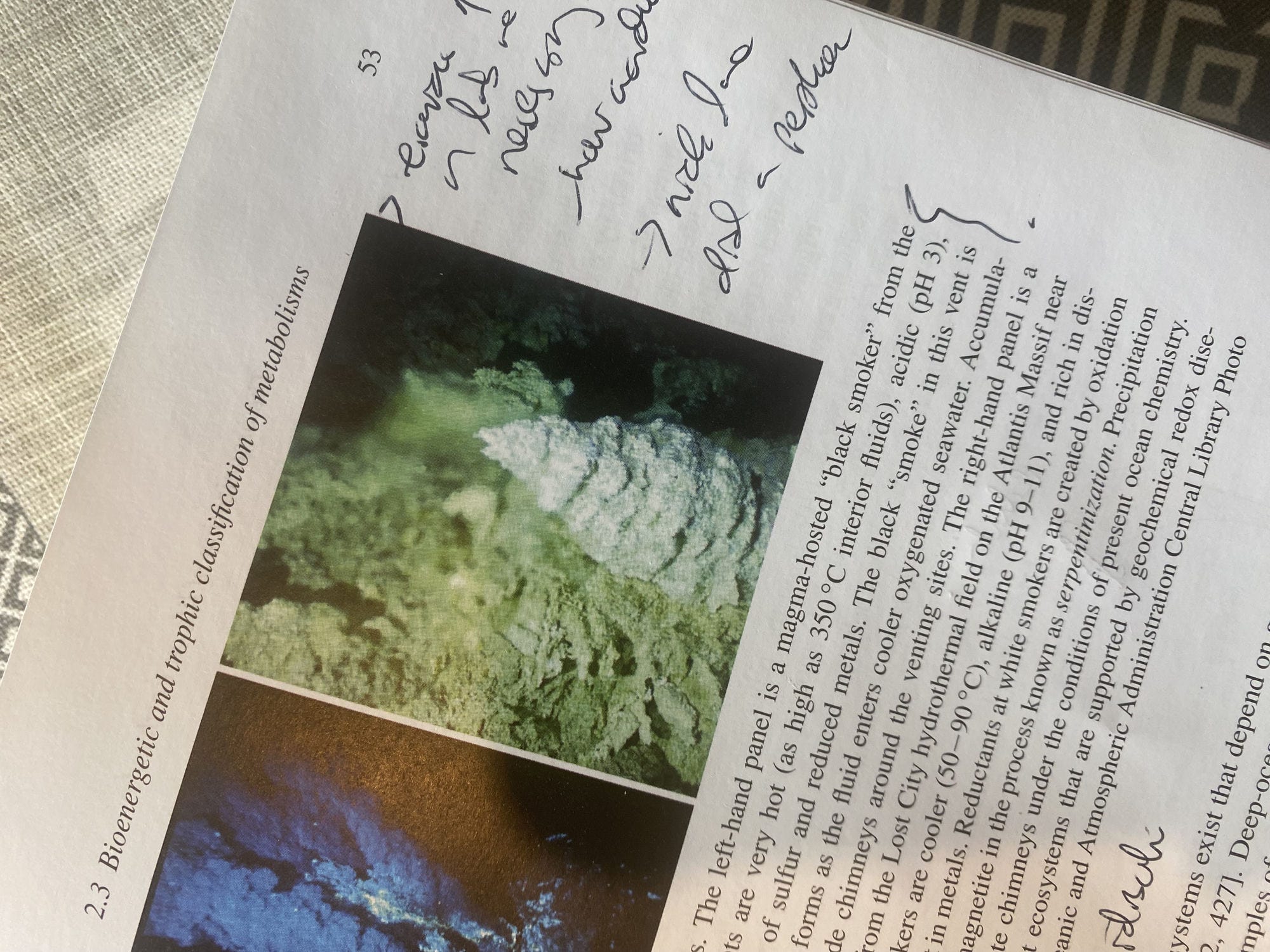
I think the final boss of verification however, is to do an experiment. If the author has claimed something, break that down into a smaller chunk and then see if you can verify that claim through an experiment. For example, something that I picked up reading Origins of Life stuff was mineral geochemistry, in particular a process called serpentinisation. This involves a mineral called olivine so I bought some to see if I could do anything with it. I also think about statistical mechanics a lot, and I'm trying to make home demonstrations of non-equilibrium phenomena, like making a thermocouple.
Practical tips
In practical terms, I try to answer these questions in one of two ways. If I'm reading a book for the first time, I usually just read it with a pen and then scribble over the pages with my thoughts. I also fold pages a lot. Another thing I try to do is whilst I read a text, I'll dictate my notes to Claude via voice so that it records my thoughts in real time.
After that I'll try to write a list of questions, or an expository essay on what I have just read. Often times these essays end up on my blog and they become a creation of their own! But a lot of these notes end up as files on my computer waiting to be used. And then every now and again I'll leaf through the ideas to see if I can get something interesting out of it.
Using reading to make things
And then this brings us to the final step, which is using learnings to make something. Making something isn't actually the outright goal when I do this. The outright goal is to learn something, but I find that I learn things best through making something.
The cool thing above is that if I follow the process, I would've hopefully got a whole new heap of ideas, refutations, or experiments I could do once I've read something. For example, one of the assumptions that a famous author writes might be wrong, and I have a wide open hole that I could dig into. Or I might try to replicate an experiment and then get conflicting results, or find subtleties that no one has written about before (this has happened with my biohardening work!).
And once I've done this process, I'll write about what I've learned and my results, and then hopefully someone else can have new ideas by following the process above when reading my essays.
"Terry Gross: Can you share some of your favorite comments from readers that you've gotten over the years?
Maurice Sendak: Oh, there's so many. Can I give you just one that I really like? It was from a little boy. He sent me a charming card with a little drawing. I loved it. I answer all my children's letters—sometimes very hastily—but this one l lingered over. I sent him a postcard and I drew a picture of a Wild Thing on it. I wrote, "Dear Jim, I loved your card." Then I got a letter back from his mother and she said, "Jim loved your card so much he ate it." That to me was one of the highest compliments I've ever received. He didn't care that it was an original drawing or anything. He saw it, he loved it, he ate it."
I think that boy was onto something.